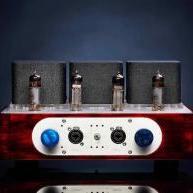
May 22, 20179 yr comment_765181 After a few weeks burn-in period of this little beast, I found it's very relaxing to listen to. I can hear more juices coming out and the STAX 009 just doesn't have that analytical sounding cliché to my ears. It also enhances the soundstage and life-like of Focal Utopia makes it way more enjoyable to hear. This is a push-pull design tube Headphone Amplifier/Preamplifier attempting to achieve the true high-performance of headphones from Dynamic, Planar Magnetic to Electrostatic models. I've gotten a few PM's asking about the schematics and stuff so I decided to open a thread to discuss more here. a few interesting measurements of the amp at R = 6Ω DT-HWT Headphone Amplifier/Preamplifier schematic: DT-HWT Power Supply schematic: ===================== Inputs – it has two sets of RCA inputs. Output – it has different outputs, provided on a number of different connectors. On the amp front is a TRS ¼” unbalanced jack, and balanced headphone outputs on a single 4-pin XLR and a pro bias 5-pin Stax headphone jack. On the amp rear, there are two sets of 3-pin XLR and RCA preamp outputs. Both sets can be used at the same time if desired – for example, you could feed a power amplifier from the XLR connectors, and a subwoofer amp from the RCA connectors. The bias voltage settings on the separate power supply unit are used only with electrostatic ear speakers (> 100K Ω impedance). You can select whichever bias level sounds better to your STAX/HE90 models from 230-500-580 up to 620 V DC bias. Tube complement for the amp unit is: matched pair of EF86/E80F/6D8 & matched pair of 12AU7/5814A/E80CC/E82CC & matched quad of EL95/6AQ5 Tube complement for the power supply unit is: matched pair of KT66/KT77/KT88/6550/6L6/EL34/350B/350A & one 6080/5998/6AS7/6H13C/2399 Look forward to those next iterations/variants from you guys soon... For the meantime, I keep on rolling 11 tubes to find the best combination that suits best for different music genres Report
May 22, 20179 yr comment_765184 Looks like a tube rollers heaven! If you don't mind telling, what's the approximate cost to build this amp? Report
May 23, 20179 yr comment_765246 12 hours ago, pham said: Look forward to those next iterations/variants from you guys soon... For the meantime, I keep on rolling 11 tubes to find the best combination that suits best for different music genres Look up any of kevin gilmore's electrostatic amps for an improvement on your amp, and most Stax amps are better as well. Added bonus, they don't need Mikhail style tube rolling to sound good. Report
May 24, 20179 yr comment_765403 On 5/22/2017 at 6:01 AM, pham said: Look forward to those next iterations/variants from you guys soon... For the meantime, I keep on rolling 11 tubes to find the best combination that suits best for different music genres One issue with replacing tubes for different music is that sooner or later, those tube sockets will loosen, causing noise problems. Tube sockets were not designed for repeatedly changing tubes. Edited May 24, 20179 yr by JimL Report
May 24, 20179 yr Author comment_765414 @Rossliew The chassis + electronic parts + OPTs + tubes for this amp run more than 4K and months of craftsmanship to finish it. @mypasswordis I also own the KGSSHV and they do have different flavors in sound signatures. Solid-state I think is not a drop-in replacement for tubes amplifier. @JimL of course, we are not talking about hundreds of times of replacing tubes a day here :_) but tube rolling for experimental results still remains an addicting hobby for many people I guess. I can't help falling to sleep at night! :_( Report
May 24, 20179 yr comment_765416 Nice! i presume the cost is secondary to the time and effort to build the chassis. But a nice alternative to the other tubed designs out there. Report
May 24, 20179 yr comment_765425 5 hours ago, pham said: @Rossliew The chassis + electronic parts + OPTs + tubes for this amp run more than 4K and months of craftsmanship to finish it. @mypasswordis I also own the KGSSHV and they do have different flavors in sound signatures. Solid-state I think is not a drop-in replacement for tubes amplifier. @JimL of course, we are not talking about hundreds of times of replacing tubes a day here :_) but tube rolling for experimental results still remains an addicting hobby for many people I guess. I can't help falling to sleep at night! :_( Re: tube rolling, understood. For another tube flavor, you could try the SRX Plus. Can be built point-to-point, tubes handle all the signal chores, but with cascode MOSFET current sources, which greatly enhances the efficiency of the output tubes. Could probably drive dynamic headphones through a transformer, but I haven't really tried that. Report
May 25, 20179 yr Author comment_765482 Can you guys imagine how sexy the sound would possibly be after rolling those babies in? a pair of vintage Osram KT66... men in black!! It's the beauty of tubes amplifier when you luckily found your gems. Report
June 4, 20179 yr Author comment_766401 After rolling in a pair of KT66 vintage Osram and Philips pinched waist ECC82, we had a very pleasant evening with this alternative setup... features: DYN Contour 30 speaker, T+A CDP/DAC/Streamer, DT-HWT acts as pre-amp, Rotel power-amp and a bunch of frey, heimdall, red blue Nordost cables. Report
June 6, 20179 yr comment_766587 Interesting amp. The amp section is pretty straightforward and by-the-book. I am curious, though, why did you choose the tubes you did? Was it purely for rolling purposes? I would like to point out that the output stage can't swing nearly as much voltage as most electrostatic headphone amps, but if it's enough for you, then there's no problem. Also, I notice the NFB loop is connected to only one side of the output stage, and it presents a low enough impedance to change the performance of that stage significantly, which would lead to an imbalance between the top and bottom portions of the amp. Have you considered loading the top portion similarly to restore the balance? The case and internal build quality is amazing. Report
June 7, 20179 yr Author comment_766635 The output stage has indeed enough voltage to drive the 009 as well as other headphone models. Regarding your concern about the NFB loop -- There shouldn't be any problem because headphone impedance is way bigger than Z-out of the custom winding OPT's coil and the other half of feedback loop does have the same signal phase just got inverted. Our design concept is to minimize the number of voltage gain stages usage and try to rely fewer capacitors on the audio signal out path. Usually, other amp tends to have 3 or more stages and twice the amount of output capacitors for each channel comparing to DT-HWT. On the next iteration, we will use only a single voltage gain stage design to achieve the most direct musical sounding out. Report
June 7, 20179 yr comment_766657 10 hours ago, pham said: The output stage has indeed enough voltage to drive the 009 as well as other headphone models. Regarding your concern about the NFB loop -- There shouldn't be any problem because headphone impedance is way bigger than Z-out of the custom winding OPT's coil and the other half of feedback loop does have the same signal phase just got inverted. Our design concept is to minimize the number of voltage gain stages usage and try to rely fewer capacitors on the audio signal out path. Usually, other amp tends to have 3 or more stages and twice the amount of output capacitors for each channel comparing to DT-HWT. On the next iteration, we will use only a single voltage gain stage design to achieve the most direct musical sounding out. So just to point out, the SRX Plus, based on the Stax SRX DIY design, has two differential amplification stages (first is cascode) and only one cap between input and output stages. The Plus refers to the use of MOSFET cascode constant current sources (CCS) replacing resistors to optimize circuit operation. The CCS set the circuit operating parameters but the tubes do all the signal amplification. Report
June 7, 20179 yr comment_766661 Is this an MOT thread? Seems like it...Sent from my iPhone using Tapatalk Report
June 7, 20179 yr comment_766682 Single gain stage in an electrostatic amp is beyond retarded. Now don't get me started on using transformers but a single gain stage? Report
June 8, 20179 yr Author comment_766728 @spritzer input -> a single VAS -> current buffer stage -> step-up OPT @100VoltTube Every musical instrument or everything that makes sound creates its own signature pattern of harmonics that defines it. The pattern defines the timbre or the “voice” of the sound and tells you that the note you hear. Typically, the patterns people find most appealing and most musical, are even-order harmonics. Tube amplifiers have more distortion than solid-state ones, but most of it is second-order, which is quite musical, natural and pleasant to hear. That's why it's called "harmonic" distortion. Report
June 8, 20179 yr comment_766733 Distortion is still just that - distortion. Gimme wire with gain............. Report
June 8, 20179 yr comment_766734 So a gain stage is some how worse than a buffer stage and a step up transformer? Sure... this is the Craig Uthus line of thought. Let's paint all the way into the corner and then pretend it doesn't sound like shit. Report
June 8, 20179 yr comment_766742 On 5/22/2017 at 7:01 AM, pham said: I can hear more juices coming out and the STAX 009 just doesn't have that analytical sounding cliché to my ears. I can recall one time while listening to Chris Isaac, that I thought juices were coming out of the Stax 007 I was listening to. After further investigation, I became aware that the source of the juices was much lower. Report
June 8, 20179 yr comment_766763 Harmonic just means integer multiples of the fundamental frequency, whether they are odd or even. If you really want to get into musical harmony, the perfect fifth is not an even multiple of the fundamental with an interval ratio of 3:2 and neither is the major third, which is an interval ratio of 5:4. Even order harmonics represent octaves, which strengthen the fundamental which may or may not even be present, giving a larger than life ringing tone. A combination or Tartini tone is most commonly produced using a fundamental and its fifth, in which a common subharmonic is heard psychoacoustically. Overtones are any frequencies above the fundamental frequency. tl;dr solid state haters need to seek haven somewhere else. Edited June 8, 20179 yr by mypasswordis Report
June 9, 20179 yr Author comment_766827 I built and own a KGSSHV for Stax and do enjoy listening to the Goldmund headphone amp with other dynamic models. The legendary T2's parts sourcing is also in progress during my spare time. Beside these solid state amps, I'm lucky to have a chance to experience other great tube amplifiers including Kondo Audio Note (not the one in the UK). I really wish to somehow send this amp over there to you guys or if I could manage to find time to build a few self-assembly kits... Because in the end of this hobby, it's not the exact specification that counts. Let's just turn on your fav music and chill out. Report
June 9, 20179 yr comment_766845 Wow, for expensive speakers, those sounded oddly as bad as the crappy speakers in my PC! Report
June 9, 20179 yr comment_766849 Didn't sound too bad from my RS220 fed off a Xonar STX sound card.......but, as usual YMMV....... Edited June 9, 20179 yr by wink Report
June 9, 20179 yr comment_766852 On 6/7/2017 at 10:07 PM, pham said: @spritzer input -> a single VAS -> current buffer stage -> step-up OPT @100VoltTube Every musical instrument or everything that makes sound creates its own signature pattern of harmonics that defines it. The pattern defines the timbre or the “voice” of the sound and tells you that the note you hear. Typically, the patterns people find most appealing and most musical, are even-order harmonics. Tube amplifiers have more distortion than solid-state ones, but most of it is second-order, which is quite musical, natural and pleasant to hear. That's why it's called "harmonic" distortion. Although it is true that tube amps tend to have higher measured distortion than solid state, IMHO a properly designed tube amp or preamp has low enough distortion that it is inaudible. As with all class A amps, distortion generally goes down as levels decrease, so a typical listening levels which is usually at least 20-30 dB below clipping for electrostatic headphone amps, measured distortion tends to be buried by noise. I agree that tubes sound different from solid state, I just don't buy that tube sound is due to "pleasant" distortion. Report
June 9, 20179 yr comment_766873 6 hours ago, wink said: Didn't sound too bad from my RS220 fed off a Xonar STX sound card.......but, as usual YMMV....... Show off! Report


Join the conversation
You can post now and register later. If you have an account, sign in now to post with your account.