

Leaderboard
-
Absorbine_Sr
High Rollers16Points8097Posts -
Hopstretch
High Rollers9Points16809Posts -
Voltron
High Rollers7Points34606Posts -
Craig Sawyers
High Rollers6Points5520Posts




Popular Content
Showing content with the highest reputation on 07/25/16 in Posts
-
9 pointsSending Shelly off with some Giordano's Chicago Classic. Sent from my iPhone using Tapatalk9 points
-
Tufa in Mono Lake. Sand Dunes, Panamint Valley, CA. San Juan de Gaztelugatxe, Spain. 12 August 1958 at 17 East 126th Street, between Fifth and Madison Avenue in Harlem. Click for slightly barker. 12th century Byzantine Church, Chios Greece. Mt. Shasta as seen from Mt. Ashland, Oregon. Bonsai Rock at Lake Tahoe. Leukerbad, Switzerland. Winter Park-Fraser Valley, Colorado.3 points
-
2 points
-
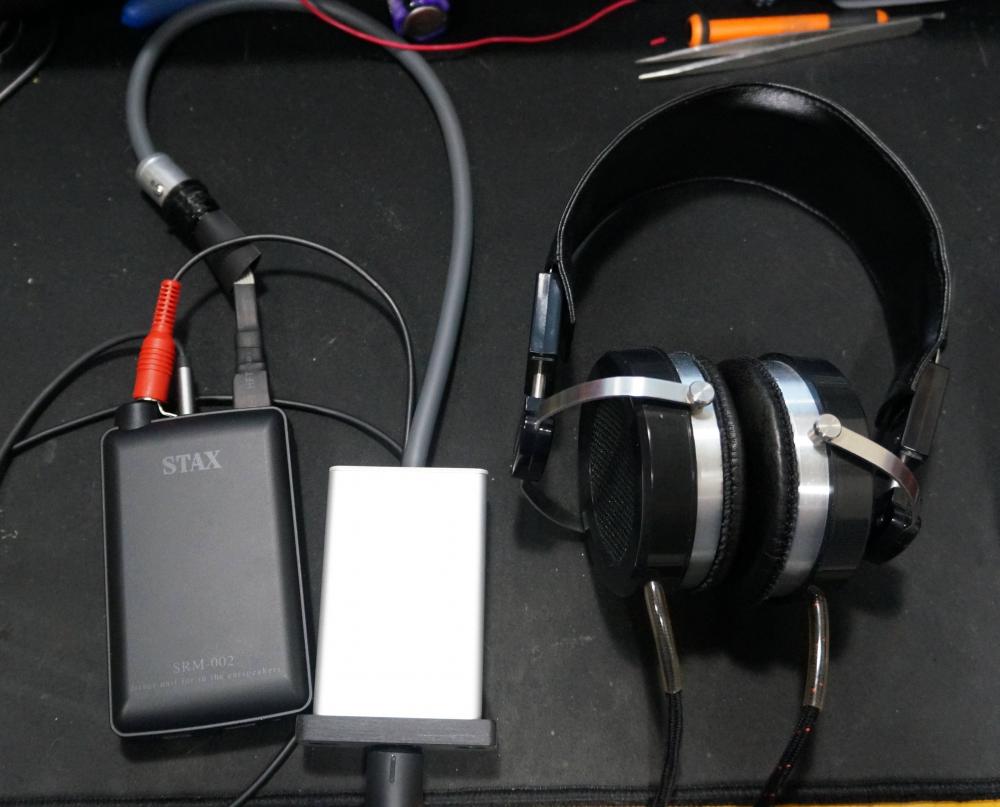
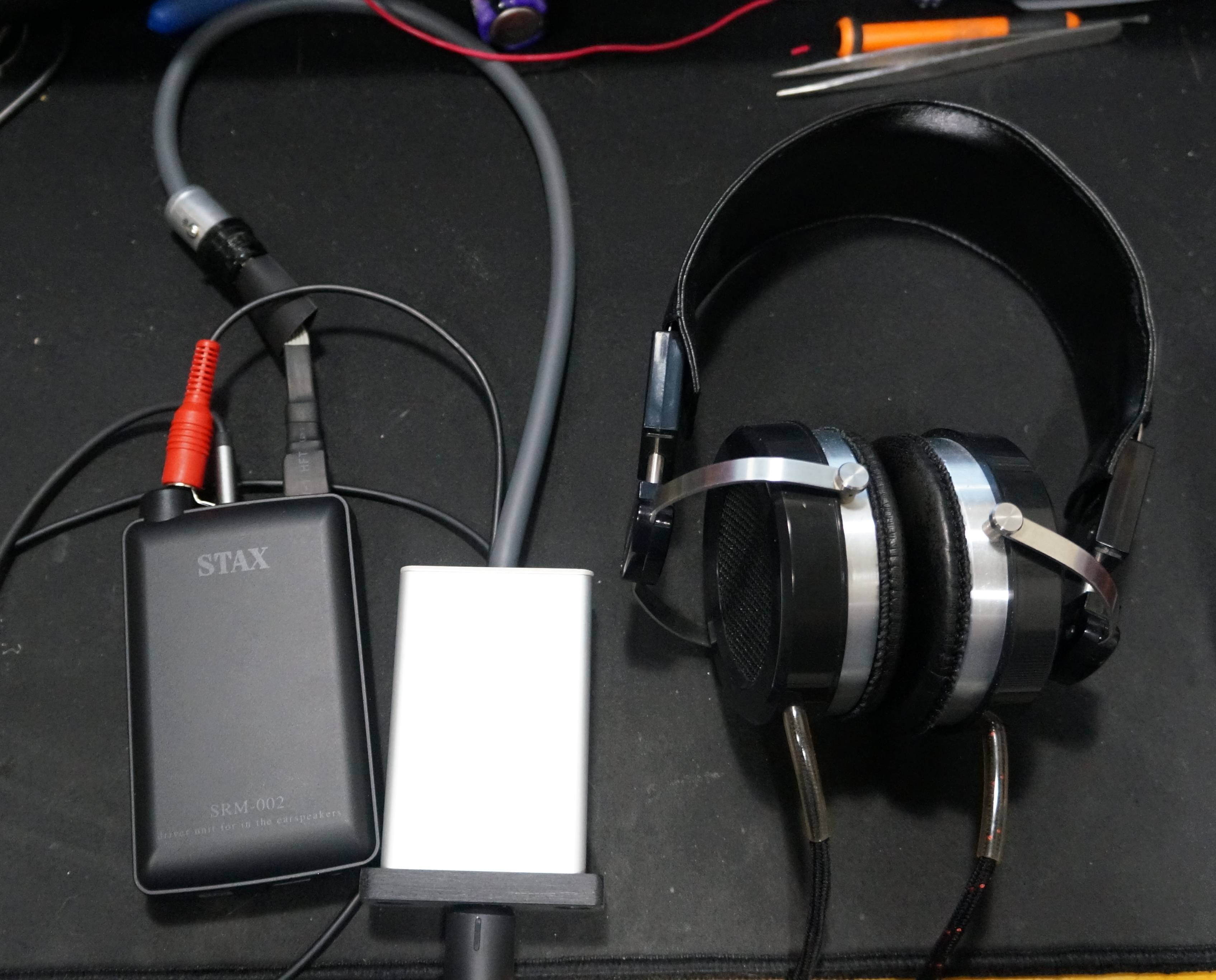
2 points2 points1 pointHer shirt is not appropriate attire for Giordano's. So they probably made her pizza even bigger.1 point1 pointTalked to their rep today and their new 4K Blu-ray should be out at the end of the year. No replacement plan for the Oppo HA-1.1 point1 pointTeaching your grandmother to suck eggs? Of course this has been covered here a bazillion times. We also deal with high voltage, most papers out their don’t cover this aspect (including the one you’ve reference).1 point1 point1 pointActually, you maybe right. I love the BHSE so much due to its unsurpassed build quality. However, I know that Mulveling could really give it a good home for me. Also, the T2 does get hot and Atlanta can be quite warm in the summer. I remember having both the T2 & BHSE on together and they did warm up my small listening room. Thanks for confirming that. I really love the Carbon and I hope to be able to keep it too.1 point1 pointand not different in any way ... you can consider yours as a V6.0 Carbon1 point1 pointHmm, when you mentioned downsizing amps I thought Carbon, T2 and Aristaeus would be the last ones standing.1 point1 pointDrove out to Calgary on Friday to see Ne Obliviscaris, Black Crown Initiate, and Starkill. The local opener was called Divinity, and they were great. Starkill were really fun, melodic death metal. Black Crown Initiate: very good, talented, not entirely my cup of tea. Technical death metal I guess is their sub-genre. Ne Obliviscaris - wow, just wow, they were amazing. A six-piece extreme (whatever that means) metal band with jazz influences, epic, moody instrumental breaks, two lead vocalists, and a violin of course. One of the best drummers I've ever seen. I talked to some of them after the show, and they were seriously nice dudes. They're from Australia, and this is their first headline tour of North America. Dusty, you really need to check them out when they play Baltimore on Aug. 2. I have no concert footage, but here's their most recent album. @Dusty Chalk1 pointI don't think they'll kill it it, but I'm not hopeful they'll leave it alone/make it better either since they're supposedly merging Yahoo with AOL.1 point1 pointIt was very entertaining. I liked Lewis driving and cleverness trying to have Ricciardo taking over his team mate. Not that the team was loving that idea though Excellent result for McLaren and Fernando Alonso, now they just have 3 teams ahead I wish they keep that fourth place as a team in the future, and this is a hint of 2017 season.1 point1 point1 pointI've been listening to my SRS-002 system these past few days (thanks @justin ) and I have to say these little things rock! I've put probably 20 hours of listening time in at work and I am digging them for sure. This is the best portable setup I've heard, and at the price I can't imagine you could do much better. Fit is not an issue for me thankfully! Now for something stupid. I couldn't leave well enough alone so I made a full size Stax adapter and sampled some of my other phones on the SRM-002. It doesn't have the guts to properly drive any of my Lambdas (obviously) but it actually does surprisingly well with my SR-X Mk3. What you see there is my SR-X Mk3 -> Pro Bias to Normal Bias adapter -> 5 pin Stax to mini Stax adapter -> SRM-002. This was done for kicks of course and is not to be taken seriously. In a few days I will be building the much more useful reverse of this adapter so I can use my SR-002 on my SRM-727.
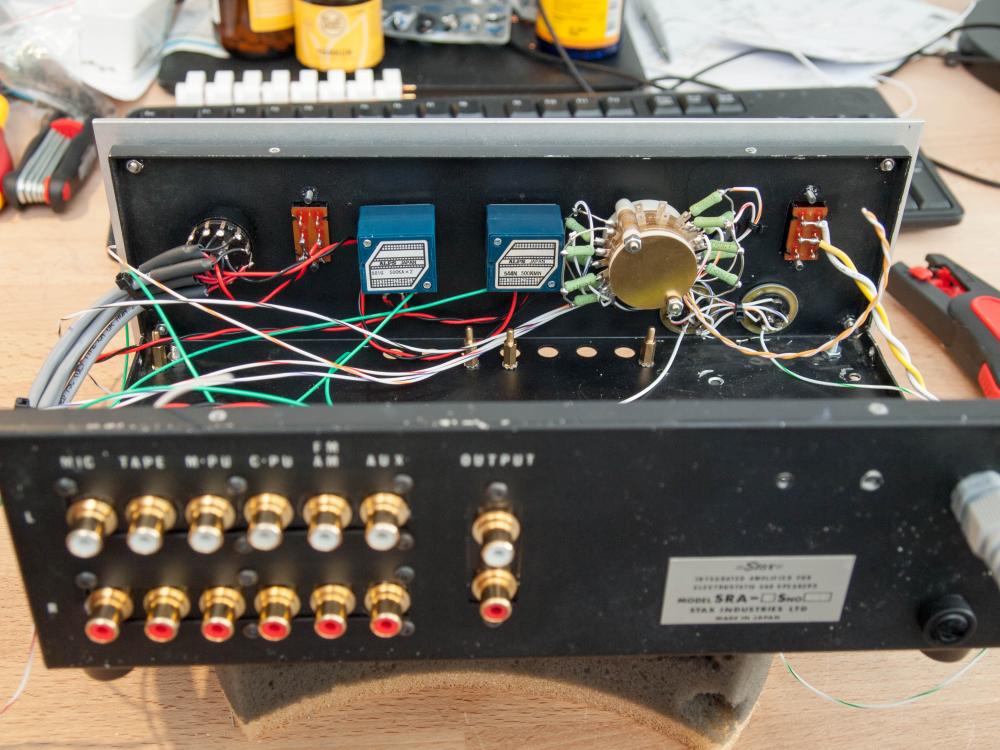
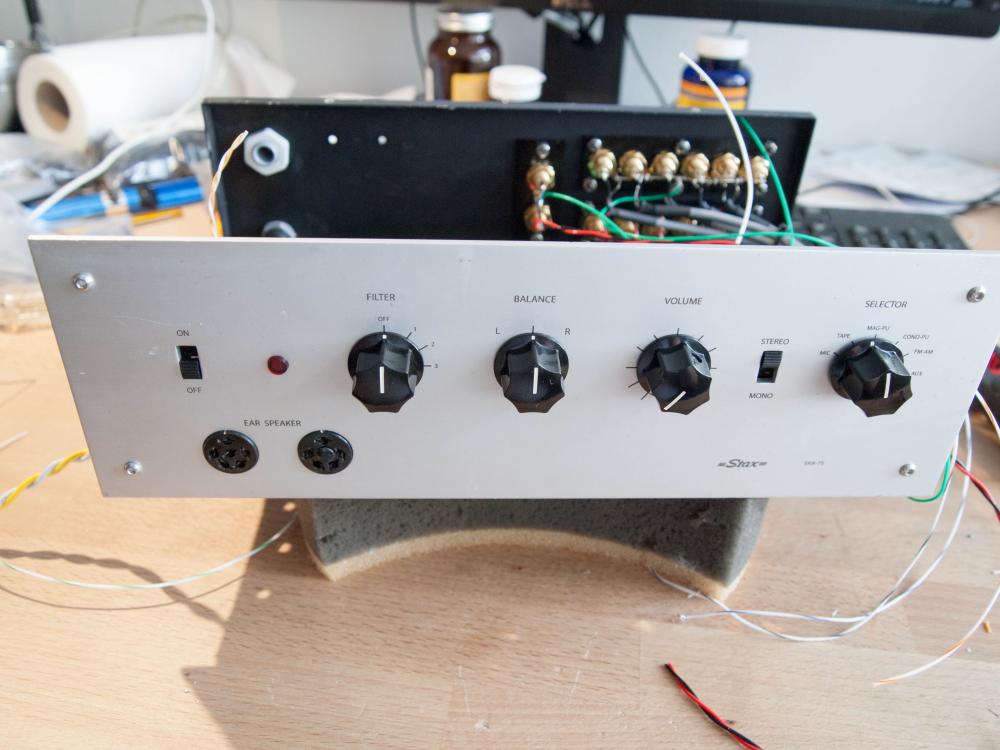
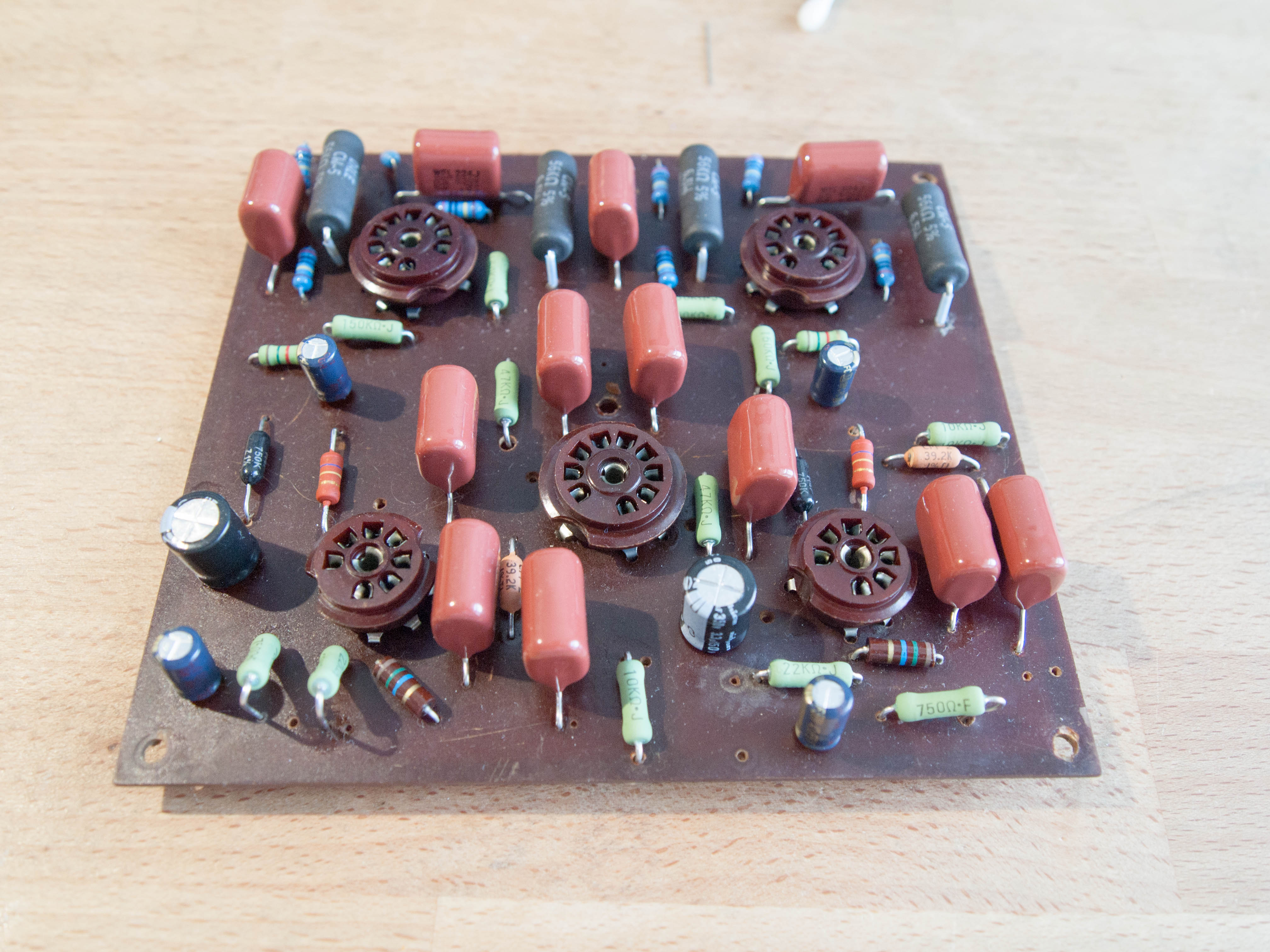
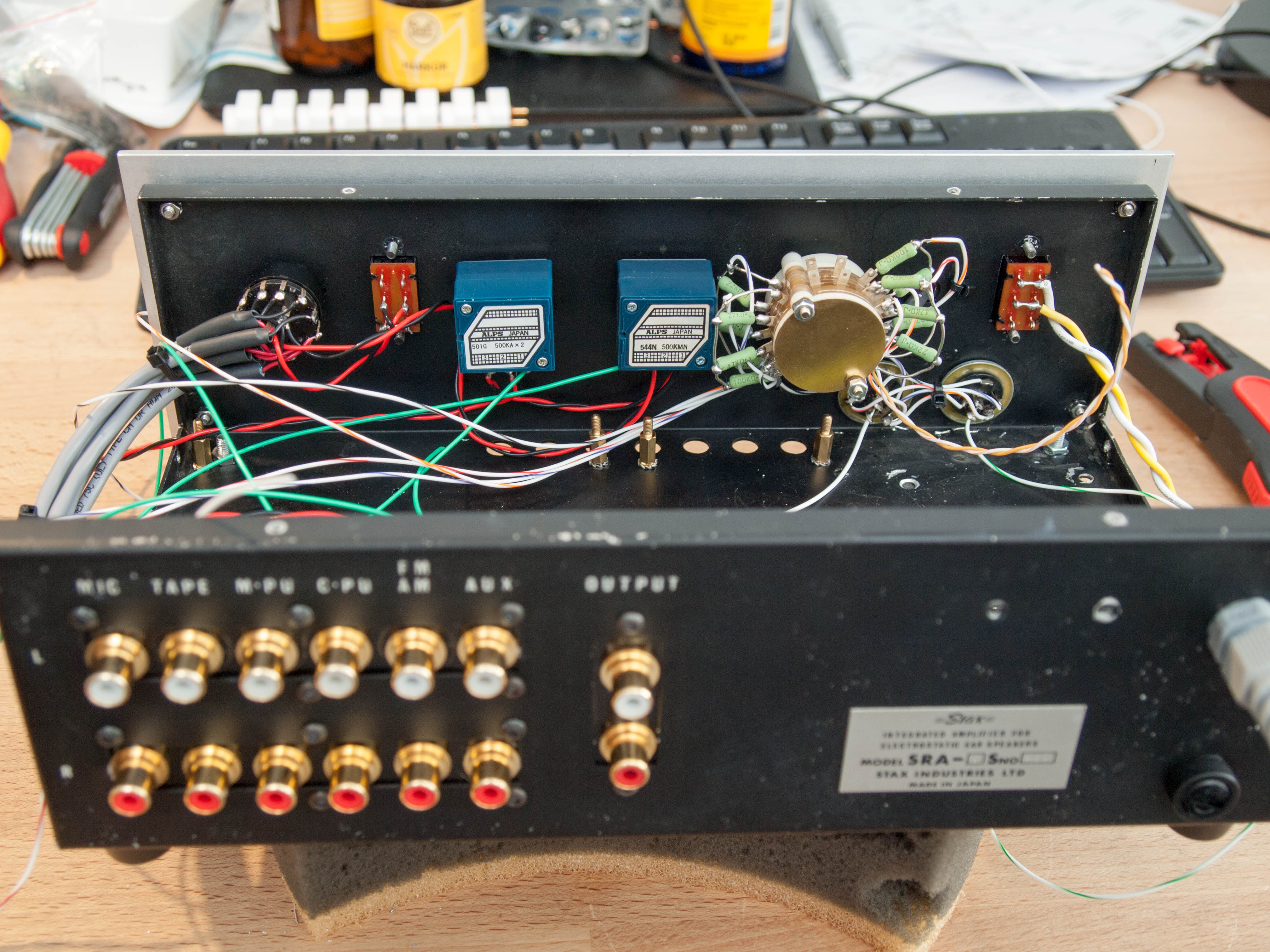
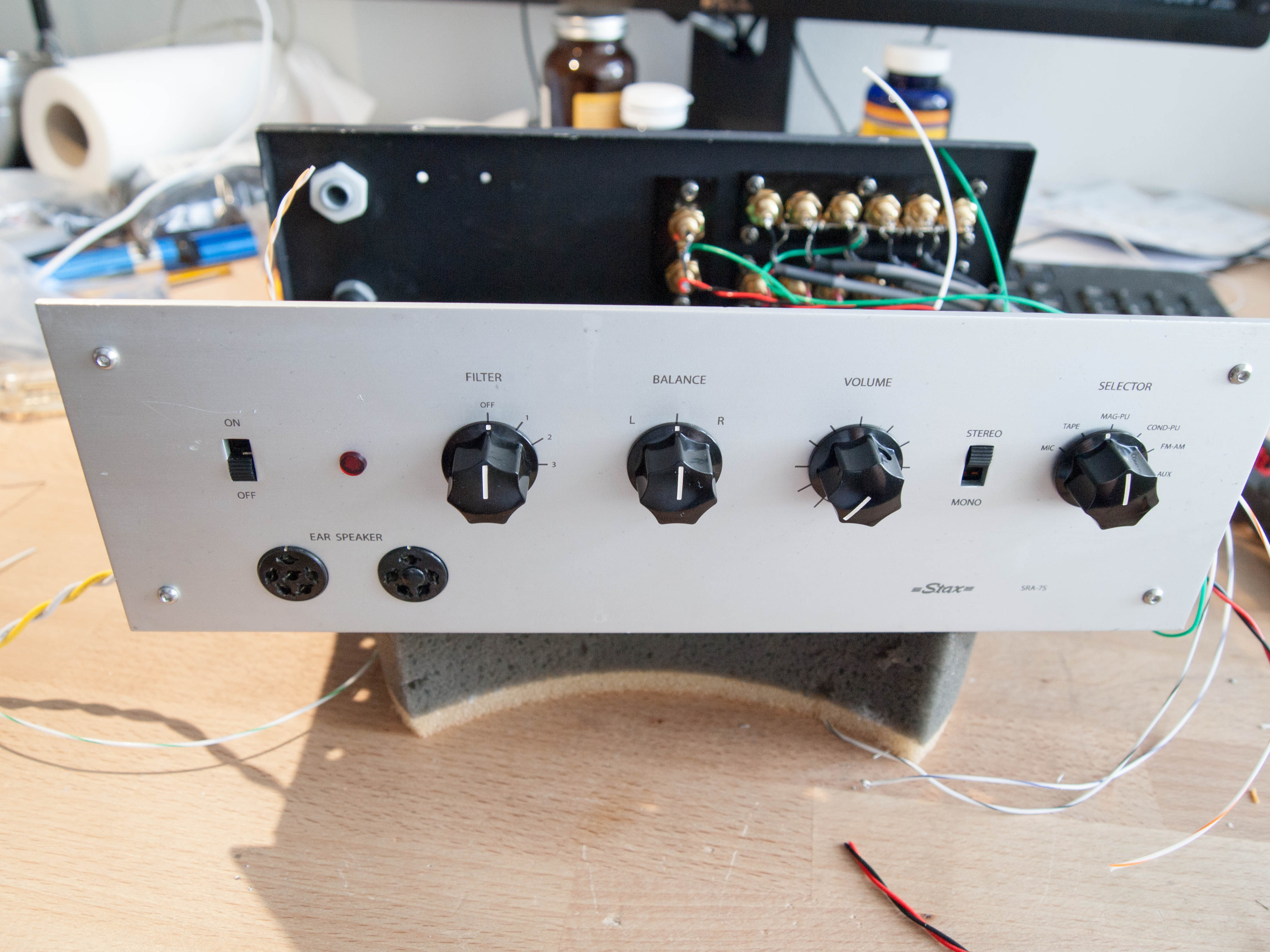
 1 point1 point1 pointyou are right, the Carbon boards are v6 ....but since we are in July I thought why not call the Group Buy V7.0 ;o)1 pointNot sure where to post this but it might just as well be here, an update on the ongoing restoration of my SRA-7S. This is more a of complete rebuild/redesign but I digress. I bought the amp some 3 years ago for way too much and well...it was filthy and full of parts which were way past their use by date. Also the transformer was 100V only so the only solution would be to remove everything and start from scratch. Now I don't recommend doing this...like at all!! The amp is about the same size as the SRM-323 but with way more crap crammed in there. There are also some design issues which needed to fixed plus I needed to decide what to do with this thing. Since vinyl is dead to me, the phono stage was of no use so I left it out. That gave me enough space to fit a regulated PSU and a larger transformer. Just barely though. First up was the main amplifier PCB, I stripped of everything but the tube sockets and in went new parts: It was littered in carbon comp resistors and paper caps so they all had to go. Funny though that the values for each component are written in pencil on the back of the PCB. Now for the chassis and I decided that new RCA's were the only way to go plus is needed all new pots and switches. Stock values except for the filter section. It was single ended in the stock design but here I used all four channels so the values were halved. I'm replicating all of the features so the full 6 inputs are wired and even the mono switch. Way too much work but there is also no rush. Now the front panel was a problem. When it came here it was pretty disgusting. Some 50+ years of dirt and grime so when I tried to clean it, all the labels washed off. What you see here is in effect a reproduction of the orignal markings on the stock panel. This time done by laser so it will last forever. I went with the shorter switches for the power and mono/stereo for a sleaker look. The knobs are all brand new but they are identical to the stock ones. Sato still make them...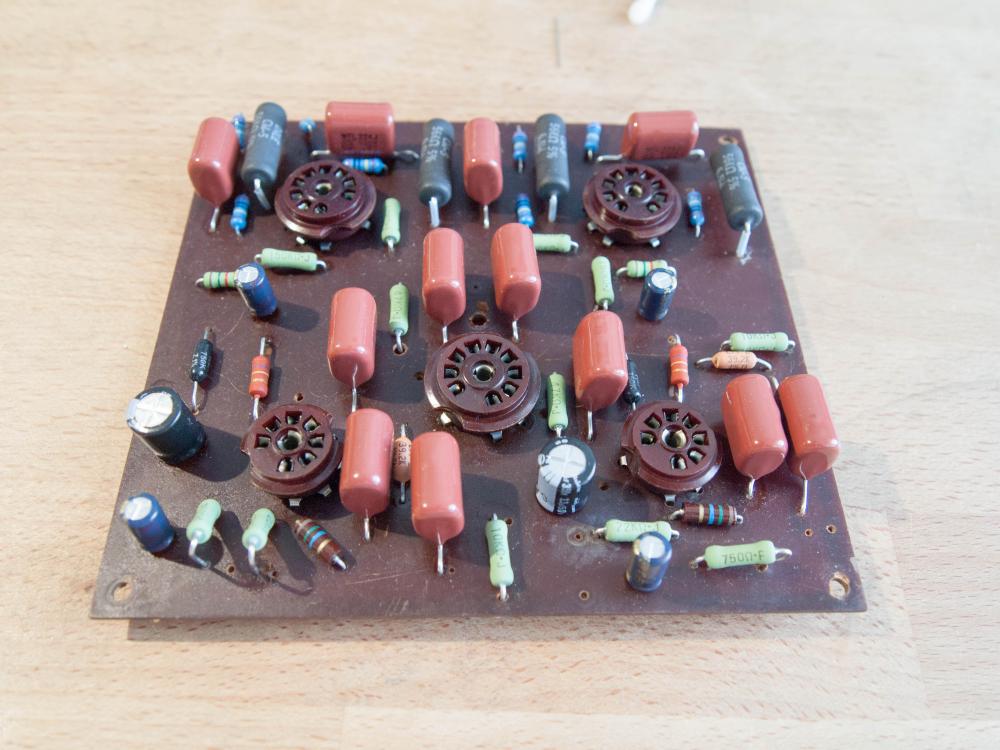
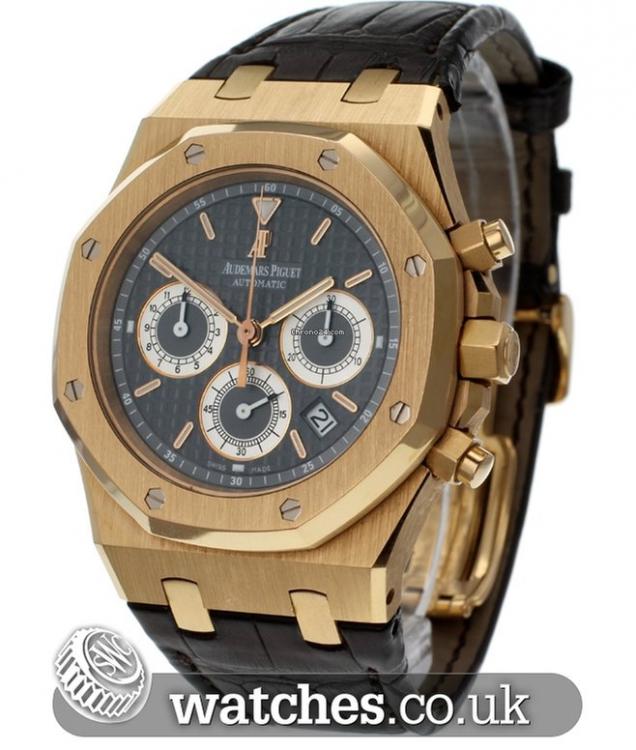
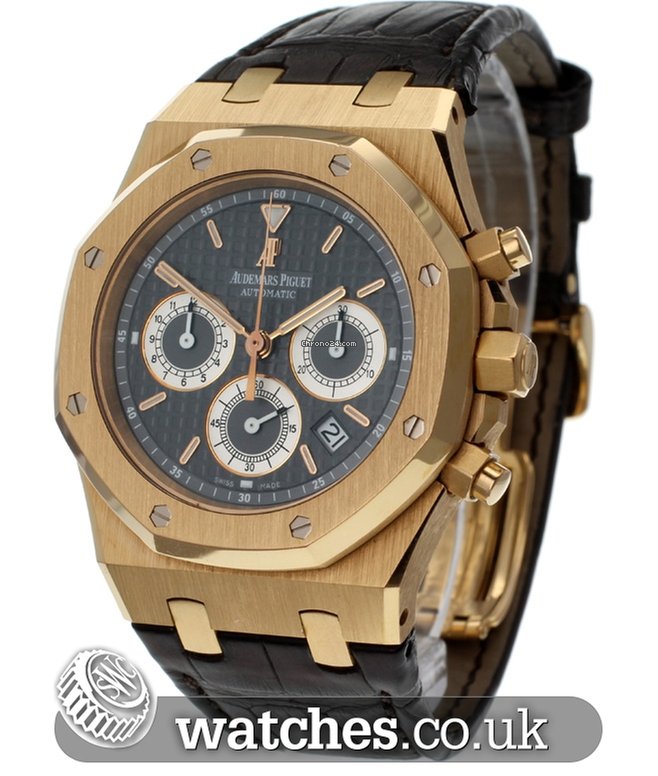
 1 point1 pointAbsolutely agree as a technical matter that being able to swing full voltage at 20 kHz is better than not being able to. The SRX Plus, for example, is not able to do so, and in fact, as I posted in that thread, actually measurably rolls off at lower frequencies as the output voltage increases (it's flat at 100 VRMS to over 20 kHz which is pretty loud, though). BTW, KG's calculation is actually a minimum estimate of the current required, because a stat headphone is not a capacitor - it makes NOISE, e.g. music, which means it has to consume ADDITIONAL current over what a capacitor requires. However, as Dr. Gilmore points out, the question is, how loudly do you listen and how much actual audio content is there at 20 kHz. There is actually some data on the latter point. A number of years ago, Peter Baxandall and Nelson Pass both measured slew rates in recorded music and both came to similar conclusions, namely that an amplifier capable of reproducing a 6 kHz sine wave (yes, 6 kHz, that is not a misprint) with low distortion is adequate for music signal, because of the natural roll-off of musical instruments. Note that this was equivalent to the fastest music signal they found, and that everything else they measured was SLOWER than that. More recently, Baxandall published that he had found a recorded music signal that required an amp to be capable of reproducing a 15 kHz sine wave with low distortion. That is significantly faster, and in fact is within striking distance of the 20 kHz signal at full output voltage requirement - however, it must be noted that this is a unique event, and for almost all music the lower requirement is adequate. Is it appropriate for a state of the art amplifier to aim for the more stringent requirement? Absolutely! Will the lower requirement suit the needs of most? Probably. Of course, extra headroom is always nice - but there is a cost. For Stereophile Class A, the cost is always worth it, almost by definition. For Stereophile Class B, the question is, how much can you cut back for as little sonic cost as possible. Finally, if you listen at lower levels, the requirements decrease accordingly. This is why spritzer suggested to Tyll that he listen to electrostatic headphone amps at high levels to differentiate between them - because this stresses the amp the most.1 point1 pointI posted this over there, will post here. if I had time I would find to do a way to do the graph that shows frequency response relative to output voltage, maybe in a few days if people don't get it so here is how this works Required Slew Rate = 2 x π x Frequency x Peak Voltage x K we can argue about K later, different people have different ideas about the value.The load is a capacitor and it takes a particular amount of current to charge/discharge the capacitor at a particular frequency and voltage. Lets reference the maximum peak to peak output voltage of the amplifier at 1khz as 0db. Now lets calculate what amount of current is needed to do 20khz at 0db at the same peak to peak voltage into one standard headphone load, 120pf Now lets figure out (and this part gets complicated) how much more current is needed to guarantee .01% thd at 20khz at 0db. taking into account the open loop gain. Its clear that some of my earlier amplifiers with output currents in the range of 5ma to 10ma cannot do full voltage swing at 20khz. But will do a full flat frequency response at less than full voltage swing. So the question is how loud do you listen and how much actual audio content is at 20khz relative to 1khz. It is my opinion that 20ma however is enough to do full voltage swing even with 500V power supplies. 2sc4686,2sc3675,2sc5466 etc, cannot do more than about 10ma before they eventually blow up. Even with lots of heatsinking. And ixta3n120 has so much output capacitance that even with impossible current numbers it could never get there from here. Cree C2m1000 however can run at at least 30ma at 500V power supplies, is ultra low output capacitance etc. So is the current flavor of the decade output device, till something better comes along. A couple of people think that the carbon is a bit bright at 20ma, and have turned their units down to 18ma. This is one way that the amplifier can be tuned. The performance of an el34 at 20ma begins to effect the lifetime of the tube. Significantly. emission labs 20B work fine at 20ma, but have a stupid price and questionable long term reliability. There is no free lunch.1 point1 point1 pointBlueberry pie, with blueberries we picked yesterday. It will be consumed withe some ice cream after dinner.1 point1 pointFired up my Carbon last night. Adjusted the current to 20mA but back down to 16mA at the moment as I'm afraid that my transformer can't stand it. Being lazy, I utilize the power supply and chassis from my KGSSHV. So I should consider it as an upgrade. I'll buy a new transformer and adjust the current to 20mA later. The amp is running at 450V. Even at 16mA I can feel that it's running a lot hotter than my previous KGSSHV. The amp sounds wonderful. Thanks Kevin for sharing this wonderful amp design.1 point1 pointSpeaking of chronos. Very tempted. The rose/grey/rose shouldn't really work but oof ...
 1 point












Important Information
By using this site, you agree to our Terms of Use.